Thursday, November 10, 2011

Possibility of 72 Game Season, Stern Says

After adjusting last night's proposal, David Stern suggested the NBA would play a 72-game season beginning December 15, should the union accept their latest and most likely best offer. The playoffs and NBA finals would likely each be pushed back a week, according to Adam Silver

If the players reject the new offer, Stern's proposal will revert back to the 47% BRI.

"If we don't get a positive response, the revised offer starting at 47% and flex cap will be our revised position," Stern was quoted as saying in tonight's press conference.

Player representatives will meet early next week to read over the proposal.

"We have made our revised proposal and we're not planning on making another one," Stern said.

My take: This is great PR by NBA and Stern. He not only gave the public a timeline and a roadmap to a 72 game season, but he makes the players look like dicks if they don't sign their proposal.

More to come...


Make or Break Day for the NBA, Union

After a 12-hour plus negotiating session that bled into early Thursday morning, the NBA and players union are back at the bargaining table this afternoon in what is being billed as a make or break meeting.

David Stern acknowledged that both sides went well past his own 5 p.m. wednesday deadline for the player's union to accept the NBA's latest offer. However, in what could be considered a good sign, both sides continued negotiating and only ended their session due to the late hours of the night. Today's meeting is an extension of last night's negotiations.

The players feel as though they have already conceded 4.5% of their BRI and it is unlikely they are willing to move past 52.5% (from 57%). Meanwhile, the NBA offered a take it or leave it 49 to 51 BRI split along with contracts not lasting longer for 5 years if the player stays with his current team and four years for free agents, as well as a soft salary cap, according to ESPN.com

If a deal does not get made today there is a good possibility that the player's union will decertify. I encourage anyone who is interested in learning about decertification and its impact to read Larry Coon's Nov. 5 column. I would also recommend to follow him on Twitter (@larrycoon) for the latest information and explanations of that complicated info.

Here's a rather large snippet from Coon's column:

Once the union decertifies, the collective bargaining process would be over -- there literally would be no union with which the owners could negotiate. Billy Hunter, Derek Fisher and the other players on the executive committee would no longer be in charge -- as a practical matter, control would pass to attorneys. The players also could not reassemble the union for one year without the league's consent. However, such consent obviously would be granted if the two sides eventually cut a deal.
Once the union decertifies, the owners could pursue one of three strategies:

  • They can end the lockout, open the doors to the players and start doing business without a salary cap or any of the other mechanisms that existed in the CBA. They would be abandoning the very protections for which they are locking out the players, and which they have enjoyed for decades.
  • They can end the lockout, open the doors to the players and unilaterally impose a new set of work rules without collective bargaining. This strategy would surely result in an antitrust challenge by the players. It would also implement an economic system the owners don't want, as the new rules would be designed to withstand such a challenge.
  • They can continue the lockout, hoping to wear down the players. This strategy would also be met with an antitrust suit, and the owners would be hoping that the players wear down before the hammer falls. This is the most likely of the three scenarios.
I hope it does not come to decertification. From what I can gather, decertification puts the NBA season in the court's hands. The lockout has been in effect for 133 days now, longer than the NFL lockout, which also had its union decertify.
Not exactly the look of a leader

I know some see last night's session as progress. I would have to disagree. Cynically, both two sides sat across the table from each other for 12 plus hours, with a deadline and the possibility of decertification looming over them, and could not deliver any evidence of significant progress. I have little faith that today's negotiations would yield different results. Hopefully, I am dead wrong.

While decertifying the union would give the players much needed leverage against the owners, it will also increase the likelihood that more regular season games and possibly the entire 2011-2012 season will be canceled.

Friday, November 4, 2011

Being Average Sucks: 2003-04 Portland Trail Blazers

The 2003-04 Portland Trail Blazers were a sociological experiment gone horribly wrong. This was the final year of the "Jail Blazers" era. A well-earned moniker given to the team by the local media that quickly spread nationally. Ruben Patterson (sexual assault), Rasheed Wallace (weed), Qyntel Woods (weed/dogfighting...yes, dogfighting), Damon Stoudemire (weed), Darius Miles (weed), Zach Randolph (you name it), all played for the Blazers in 2003-04 and all had issues with the law.

The 03-04 Blazers will also be remembered for their Feb. 9 trade that sent Rasheed Wallace and Wesley Person to the Hawks for Shareef Abdur-Rahim, Theo Ratliff and Dan Dickau. In December, the Blazers traded Bonzi Wells for Person and a first rounder.

Let's see how they perform...my take: not enough white guys (that sounds bad).

Inserting Willie Green into your starting lineup would be a major upgrade.
Their starting five following the Sheed trade for the rest of the season was Mighty Mouse, PG, Derek Anderson, SG, Darius Miles, SF, Zach Randolph, PF and Theo Ratliff, C. This starting five went 15-13. Not bad. The aforementioned Ruben Patterson and Dale Davis came off the bench for the Blazers. WG would not be an upgrade. I'm not sure if fast Willie would ever be an upgrade actually.

Poor attendance
15th. Right in the meat of mediocre. This is good. Plus fans in the pacific northwest were tiring of the Jail Blazers' tomfoolery. So the attendance numbers were probably falling rapidly.

Win less than three games in the playoffs
Okay, this is my bad. The Blazers did not make the playoffs in 2003-04 season. Major oversight on my part. That being said, it was fun looking up half the roster's mugshot photos.

At least two white guys in their regular rotation:
Aryvdas Sabonis left the team after the 02-03 season.Vladamir Stepania played in 42 games and the pride of Hatboro-Horsham, Matt Carroll played in 20, but no, the Blazers lacked the needed two white guy minimum to maintain mediocre status.

Wow! that's Mediocre! Factor
Blazers were only one game below .500 (24-25) before trading Wallace and managed to finish their remaining 33 games at one game above .500 (17-16). Unfortunately, I think the 2003-04 Blazers were just caught in a downward spiral. Like when Dorney Park takes a picture of your screaming face in the middle of a roller coaster. The year before the Blazers won 50 games. The next season, the Blazers only won 27 and fired coach Maurice Cheeks mid-season. They were a talented group, led by Wallace, but in the end, they were just a bunch of screaming faces. Fun to research, but probably not the most mediocre team since 2000.

Check back for the 2010-11 Philadelphia 76ers.


Not Good.

Looks as though the NBA is losing the attendance battle to...soccer? Somehow Major League Soccer (MLS) games have averaged a little over 17,000 a game this season. That's a 6.6% bump from last season, according to the news site examiner.com.


That bump also pushed the soccer league into third in attendance among America's major league sports. The NBA is now fourth and likely falling.

I don't know, maybe someone is cooking the books here (bigger stadiums, less games in MLS etc...) but the message is clear: basketball is on the verge of destroying itself.

What would you rather watch?


OR

Thursday, November 3, 2011

Being Average Sucks

Late last night I started looking over my posts from last season, reminiscing about simpler times. During a gap between good, solid cries, I came across a post I wrote in February, imploring the Sixers to make a trade at the deadline in order to, you know get people actually excited about the team. They stood pat, finished 41-41 and no one cared.

I started thinking about last year's Sixers squad and how obvious it was that they were going to finish .500. That got me thinking some more...let's figure out the most mediocre team since 2000!

Here are the 16 teams that finished 41-41 since 2000.
Ugh.
00-01 Pacers
01-02 Bucks
02-03 none
03-04 Bucks, Hornets, Blazers
04-05 none
05-06 Pacers, Bulls, Jazz
06-07 Nets, Wizards
07-08 Raptors, Blazers
08-09 Sixers, Bulls
09-10 Bulls
10-11 Sixers

In order to find the MOST mediocre team since 2000, I had to make some cuts. I decided to eliminate a team if...
  • the team had any all-stars (makes your team somewhat relevant)
  • the team had any future Hall of Famers (Hall of Famer makes your team relevant)
  • the team ranked in the top10 in attendance (not as mediocre if people still like seeing you play)
  • the team did not make playoffs (weirdly, only 14 out of 30 teams miss the playoffs in the NBA, we're looking for number 15 here people)
  • the team won a playoff series (too good to be mediocre)
Eliminated
2000-01 Pacers (Reggie Miller was an all-star/future hall of famer)
2001-02 Bucks (Ray Allen/Glenn Robinson were an all-stars/didn't make playoffs)
2003-04 Hornets (Baron Davis was an all star)
2005-06 Pacers (Jermaine O'Neal was an all star), Bulls (2nd in attendance), Jazz (9th attendance/did not make playoffs)
2006-07 Nets (Kidd future hall of famer/won playoff series), Wizards (Gilbert Arenas was an all star)
2007-08 Raptors (Bosh was an all star), Blazers (7th in attendance)
2008-09 Bulls (2nd in attendance)
2009-2010 Bulls (Derrick Rose all star/1st in attendance)

This leaves us with the 2003-04 Bucks, 2003-04 Blazers and the 2010-2011 Sixers.

The criteria for Most Mediocre since 2000:
The addition of Willie Green into your starting lineup would be a major upgrade
Poor attendance
Win less than three games in the playoffs
At least two white guys in the regular rotation
Wow that's mediocre factor

2003-04 Bucks
Headcases require multiple headbands.
The Milwaukee Bucks were a mediocre juggernaut for the first half of the 2000s. From 2000 to the end of the 2005-2006 season, the Milwaukee Bucks were 246 and...you guessed it 246. Right in the heart of this lame era of basketball in the land of beer sits the 2003-2004 season.

The Bucks jettisoned Sam Cassell and Ray Allen the year before, ending the Big 3 era. The 03-04 Bucks lined up a starting five of Michael Redd, T.J. Ford, Tim Thomas, Joe Smith, Brian Skinner along with sixth man Toni Kukoc coming off the bench for the bulk of the season.

For the year, six guys averaged double figures with Michael Redd pacing the Bucks with 21.5 points a contest. The Deer were 14th in attendance and managed to make the playoffs in Terry Porter's first year as head coach, losing 4-1 to the Detroit Pistons in the opening round.

Let's put the 2003-04 Milwaukee Bucks to the test...

Inserting Willie Green into your starting lineup would be a major upgrade
T.J. Ford was a rookie with upside and Michael Redd was the heir apparent to Ray Allen, so no help there. But when you account for the remaining 3/5 of the lineup and you find Brian Skinner, Tim Thomas and Joe Smith...you got yourself mediocrity. That being said, Michael Redd holds it down at the SG spot. WG would not be an upgrade here.
White. Average.

Poor attendance
14th. That's pretty good considering the sheer lack of excitement in that starting five. But I bet Desmond Mason made a few Sportscenter Top 10 plays.

Win less than three games in the playoffs
went out in 5.

At least two white guys in the regular rotation
Toni Kukoc was their sixth man and the oft-injured Keith Van Horn was a starter when he was healthy.

Wow! that's mediocre! factor
246-246 in six years is the definition of mediocre. Not sure anyone can beat that.

Tomorrow: 2003-04 Portland Trail Blazers


Thursday, October 20, 2011

Facts and Noise: Lockout Edition

Much talk, little progress
This isn't breaking news or anything but I hate the lockout. I stopped blogging because I didn't want to write about it. My sister works for a fledgling school district in Langhorne, Pa., I worry about her. I'm far less concerned about the players bringing down their percentage of BRI (basketball-related income).

The lockout began on July 1, 201l. Since then, there's been a lot of noise coming from the players, owners, agents and talking heads. Although thanks to the baseball playoffs, hockey, college and pro football, no one really seems to notice/care. (Don't blame you). I told you my opinion and I'm sure yours falls within the confines of mine —  these rich bastards better stop arguing and get back to the game before they lose me or screw these rich bastards, I'm out.

Below are quick facts to get you caught up on the lockout and some links for opinions. If you want a more detailed history of the lockout (although why would you?) click here.

The facts:

  • All games from Nov.1-Nov. 14 have been cancelled, costing players approximately $170 million in salaries, according to Chris Broussard of ESPN.
  • The main sticking points since July: division of revenues and restructured salary cap system. 
  • David Stern and Billy Hunter brought in Federal mediator, George Cohen (worked on NFL lockout) to mediate sessions.
  • In the last 32 hours, the two sides have met for approximately 24 of them. Little progress was made in that time, though both sides are reportedly inching closer to an agreeable revenue split
  • Owners upped their offer of a $3.4mil/yr mid-level exception (MLE) to $5 mil/yr. This is down from the former MLE, $5.8/yr in the CBA from 2005.
  • Owners proposed a strong luxury tax, punishing teams for going over the salary cap. The players oppose this, saying the luxury tax would act as a de facto hard-salary cap, which of course the players refuse to accept.
The noise:
Check back tomorrow for more facts/noise.


Wednesday, July 6, 2011

Public Relations War Begins During NBA Lockout

The NBA officially locked out its players at midnight on Thursday, June 30, a move that has threatened the entire 2011-2012 season. The unofficial public relations war began at 10:45 am, Tuesday, July 5.

Yesterday, Nate Silver of the New York Times questioned the NBA's claim of financial distress. (The NBA's rebuttal is at the end of my summary of Silver's piece).

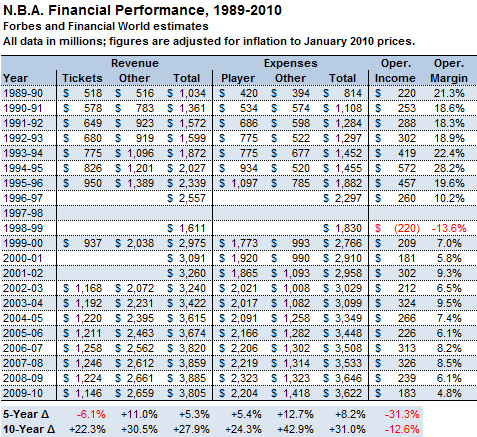
The NBA claims that 22 out of the 30 NBA teams are operating in the red. Silver pointed to independent estimates from Forbes that show a more financially stable and most importantly, healthy business in which the NBA has grown at a "tepid rate" since 1989-90 compared to other sports. Forbes estimated that 17 out of 30 teams lost money last season, but the major market teams (Knicks, Bulls, Lakers) profited close to $150 million combined and made up for most of those losses. Silver suggests this information lends itself to increased revenue sharing like the MLB.

Below is the NBA Financial Performance from 1989-2010, adjusted for inflation. The chart was cited in Silver's article from Forbes and Financial World.


The Forbes data suggests that the NBA's ticket revenues are down 6.1% compared to five years ago. Players salaries have increased 5.4% from five years ago, but according to Silver, salaries have followed a similar trajectory to league revenues. Player salaries are strictly tied to league revenue. This is the crux of the labor dispute. As of right now, the players are receiving approximately 57% of league revenues. The league wants that number reduced to 45% or even as low as 40%. But Silver points out that the portion of revenues earned by NBA players are similar to other major sports leagues.

The data indicates growth in non-player expenses has outpaced that of salaries — 13% over five years. Silver explains this by pointing out digital media ventures and overseas investments. Still, these investments have had a major impact on the NBAs bottom line, according to Silver.

The Forbes numbers suggest that the league made approximately $183 million last season, despite player salaries and large operating expenses. The league cites their own numbers which claim a $340 million loss. Silver called into question the league's claims, citing "unusual accounting treatments" and suggested that roughly $250 million were "paper losses that would have no impact on a team's cash flow."

Silver also cited the sale prices of NBA teams including the Golden State Warriors ($450 million), Detroit Pistons ($420 million) and Washington Wizards (551 million), as signs that the market for NBA franchises is healthy and above Forbes estimations of their respective worth. Silver also suggested that the Forbes estimated worth of the New Orleans Hornets matched their own financials, proving Forbes' accuracy.

Still, the NFL made more than a billion last season and the MLB made $500 million. Silver suggested that the NBA is more comparable to the NHL. In the NHL, player salaries makes up 54% of league revenues. So why do NBA owners want to cut player salaries to 45%? Well, according to Silver, owners think they can. Cutting salaries would save owners approximately $500 million per year. This is the issue. Owners have the luxury of knowing they can wait an entire year for the players to blink, get what they want and make up the losses in three years, like the NHL.

Today, the NBA countered with statistics of their own. Their rebuttal is below and in its entirety via RealGM.

The information from Forbes that serves as the basis for this article is inaccurate and we do not know how they do their calculations. Forbes does not have the financial data for our teams and the magazine's estimates do not reflect reality.
Precisely to avoid this issue, the NBA and its teams shared their complete league and team audited financials as well as our state and Federal tax returns with the Players Union. Those financials demonstrate the substantial and indisputable losses the league has incurred over the past several years.
The analysis that was posted this afternoon has several significant factual inaccuracies, including:
"(The NBA) is a fundamentally healthy and profitable business" 
• The league lost money every year of the just expiring CBA. During these years, the league has never had positive Net Income, EBITDA or Operating Income.
"Many of the purported losses result from an unusual accounting treatment related to depreciation and amortization when a team is sold." 

• We use the conventional and generally accepted accounting (GAAP) approach and include in our financial reporting the depreciation of the capital expenditures made in the normal course of business by the teams as they are a substantial and necessary cost of doing business.
We do not include purchase price amortization from when a team is sold or under any circumstances in any of our reported losses. Put simply, none of the league losses are related to team purchase or sale accounting.
"Another trick...moving income from the team's balance sheet to that of a related business like a cable network..." 

• All revenues included in Basketball Related Income ("BRI") and reported in our financial statements have been audited by an accounting firm jointly engaged by the players' union and the league. They include basketball revenues reported on related entities' books.
"Ticket revenues... are up 22% compared to 1999-2000 season"

• 
Ticket revenues have increased 12% over the 10 year period, not the 22% reported.
"17 teams lost money according to Forbes ... Most of these losses were small..."

 Forbes' claim is inaccurate. In 2009-10, 23 teams had net income losses. The losses were in no way "small" as 11 teams lost more than $20M each on a net income basis.
"The profits made by the Knicks, Bulls and Lakers alone would be enough to cover the losses of all 17 unprofitable teams." 

• The Knicks, Bulls and Lakers combined net income for 2009-10 does not cover the losses of the 23 unprofitable teams. Our net loss for that year, including the gains from the seven profitable teams, was -$340 million.
"Forbes's estimates -- a $183 million profit for the NBA in 2009-10, and those issued by the league, which claim a $370M loss..." 

• Forbes's data is inaccurate. Our losses for 2009-10 were -$340 million, not -$370 million as the article states.
"The leaked financial statements for one team, the New Orleans Hornets, closely matched the Forbes data..." 

• This is not an accurate statement as operating income in the latest Forbes data (2009-10) is $5M greater than what is reported in the Hornets audited financials.

UPDATE: Via Boston Globe: Union spokesman Dan Wasserman said the NBA projected a decline in revenues during the 09-10 season but they actually rose, so the final losses should have been much less than the league said. "So yes, we feel there is more than adequate basis for questioning their projections and financials," Wasserman said Wednesday.