The NBA and Players Association have a tentative deal in place to begin the season on Christmas day, according to an ESPN report. Both sides provided little in the way of details, but did stress that they were optimistic everything will be ironed out in time to begin the season on Dec. 25.
The league is readying to play a 66-game season with training camps set to open Dec. 9. Free agency is set to begin on Dec. 9 as well.
Showing posts with label Lockout. Show all posts
Showing posts with label Lockout. Show all posts
Saturday, November 26, 2011


Wednesday, November 16, 2011
Struggling Franchises on Different Paths
On April 11, New Jersey Nets shooting guard Sasha Vujacic drained a 23-foot three pointer with 10 seconds left, tying the game at 103 in front of a paid attendance of 13,853 (more like 8,000) at the Prudential Center in Newark, New Jersey. Following a timeout, Bobcats point guard, D.J. Augustin dribbled up the court with little resistance, used a Boris Diaw pick to create just enough space for a game-winning 18-foot fadeaway jumper with 1.1 seconds left. Nets lose 105-103. It was their last home game of the season.
That same night, former All-star point guard and current Sacramento mayor, Kevin Johnson attended the Sacramento Kings' penultimate home game against the Oklahoma City Thunder. The Kings fell to the Thunder 120-112 behind Kevin Durant's 32 points. Days later, Johnson flew to New York City to meet with the NBA Board of Governors with the hopes of keeping the Kings in Sacramento.
Tasked with staving off relocation, Johnson worked tirelessly throughout the summer, gathering support and funding for the Kings' 2011-2012 season. He quickly secured $10 million in corporate sponsorship money, financial proof that the Kings still had support from their city. Johnson's efforts paid off as the Maloofs agreed to give the city of Sacramento one more year to come up with a plan for a new arena and entertainment complex. The Maloofs demanded Johnson solidify plans and funding for a new arena in Sacramento or the team moves to another city, presumably Anaheim.
"The mayor of Sacramento has told the NBA relocation committee that he will have a plan for a new arena within a year," Joe Maloof told the Associated Press. "If not, the team will be relocated to another city."
As we approach day 150 of the NBA lockout, Johnson continues to push forward with plans for a new sports and entertainment center in the capital of California. In an issued statement, Johnson reiterated that the arena would be more than just a basketball stadium, but a job-creating entertainment complex.
Johnson hopes to have a architectural and financial plans lined up by January, but the lack of a season will temper the fans' support for the Kings. The timing could not have been worse. NBA greed, fan frustration and America's overall apathy toward the lockout could potentially derail Johnson's efforts.
Speaking of apathy, the lockout threatens to prematurely end the Nets "reign" in north Jersey. Somebody should probably inform north Jersey. The Nets are scheduled to move to Brooklyn — with prized point guard Deron Williams leading the charge — and play in the Barclays Center, the centerpiece of the proposed $2.5 billion commercial and residential development project, starting in the 2012-2013 season. But unlike the Kings, who desperately want the lockout to end for the sake of their city, Nets ownership would probably not mind if the lockout lingers just a little bit longer.
According to Forbes.com, the Nets are just one of five NBA teams that would actually lose LESS money by having a locked out season. Couple that with the Nets marketing team already working on creating a new Brooklyn fanbase, ("Jersey Strong, Brooklyn Ready" is their team slogan), and it becomes abundantly clear the team has mentally moved on.
As Mayor Johnson fights for additional funds for a new arena in the midst of a lockout with no end in sight, in city with a 12.4% unemployment rate, the Nets simply sit and back and watch as the NBA calendar to turns. A palace awaiting their arrival.
That same night, former All-star point guard and current Sacramento mayor, Kevin Johnson attended the Sacramento Kings' penultimate home game against the Oklahoma City Thunder. The Kings fell to the Thunder 120-112 behind Kevin Durant's 32 points. Days later, Johnson flew to New York City to meet with the NBA Board of Governors with the hopes of keeping the Kings in Sacramento.
 |
| The clock is ticking for Kevin Johnson |
"The mayor of Sacramento has told the NBA relocation committee that he will have a plan for a new arena within a year," Joe Maloof told the Associated Press. "If not, the team will be relocated to another city."
As we approach day 150 of the NBA lockout, Johnson continues to push forward with plans for a new sports and entertainment center in the capital of California. In an issued statement, Johnson reiterated that the arena would be more than just a basketball stadium, but a job-creating entertainment complex.
"While like many others we hope that the NBA and the players are able to come to an agreement, our focus has always been that this facility is more than just a professional basketball arena but rather, similar to what has taken place in Kansas City, an entertainment and sports complex that will generate economic activity and create jobs." via the Sacramento Bee.
Still, a canceled season will kill any momentum gathered by Johnson's best efforts. NBA columnist Scott Howard-Cooper on Grant Napeer's podcast admired the daily pep-rallies by Kings fans as the Maloof's threats to move their team grew louder and louder in the media near the end of last season.
"The team almost left and the people said wait a minute, we like them again, we want them to stay," Cooper said. "All the rallies around town and all the excitement of the team staying, it energized people in the city."
Johnson hopes to have a architectural and financial plans lined up by January, but the lack of a season will temper the fans' support for the Kings. The timing could not have been worse. NBA greed, fan frustration and America's overall apathy toward the lockout could potentially derail Johnson's efforts.
 |
| Brooklyn awaits the Barclays Center |
According to Forbes.com, the Nets are just one of five NBA teams that would actually lose LESS money by having a locked out season. Couple that with the Nets marketing team already working on creating a new Brooklyn fanbase, ("Jersey Strong, Brooklyn Ready" is their team slogan), and it becomes abundantly clear the team has mentally moved on.
As Mayor Johnson fights for additional funds for a new arena in the midst of a lockout with no end in sight, in city with a 12.4% unemployment rate, the Nets simply sit and back and watch as the NBA calendar to turns. A palace awaiting their arrival.
Monday, November 14, 2011
No Deal
I think Anthony Marrow said it best via his Twitter account: BlackBoiPachino: "We're not gonna be Strong-Armed"
Stern's Full Court Press
Below is a quick video provided by NBA.com that summarizes the NBA's latest CBA proposal. Again, this is provided by the NBA so you are only hearing one side of the story. A few of my posts from earlier this weekend detailed the player's contention with the NBA's latest offer.
If you would like to read the entire proposal, USA Today obtained a copy and can be read here. Also, Stern sent a memo to the players on Sunday, which can be found here.
According to ESPN.com's Ric Bucher, the players are not satisfied with the details of the proposal, including the new unlimited escrow system which I know nothing about, but is explained in Bucher's column. To understand the many decisions the player's face today check out Larry Coon's breakdown here.
Stern is really pushing the NBA's latest offer, trying to gather support from fans for a resolution via the media i.e. supplying the press with memos, videos and the actual document. Not sure it will work.
Sunday, November 13, 2011
NY Times Obtains Copy of NBA's Latest Proposal
The New York Times has obtained a copy of the NBA's latest proposal. According to Howard Beck, most of the details that were rumored to be inside Stern's latest proposal on Friday were either overexaggerated or simply false. In fact, after comparing both proposals, Beck wrote in his Sunday column that the league improved their offer "albeit modestly."
On Friday, sportswriters and columnists sparked rumors of owners expanding their right to send down players and cut their pay. But according to Beck, the D-League is not mentioned in the seven-page proposal.
Rumors swirled that "Bird" rights (the team's ability to exceed the salary cap to resign their own players who have been with the team for at least three years) would be threatened, as well as team's ability to use the mid-level exception (MLE). Again, according to Beck, these rumors proved to unfounded. The league actually increased the annual raise for Bird Rights players. The NBA also increased the level of the MLE for luxury tax paying teams — from $2.5 million every other year in an older proposal, to $3 million every year in the league's latest offer. (This is still a cut from last year's $5 million MLE).
Other details in the NBA's latest offer that have emerged via Beck's column:
On Friday, sportswriters and columnists sparked rumors of owners expanding their right to send down players and cut their pay. But according to Beck, the D-League is not mentioned in the seven-page proposal.
 |
| Public perception is driving Stern |
Rumors swirled that "Bird" rights (the team's ability to exceed the salary cap to resign their own players who have been with the team for at least three years) would be threatened, as well as team's ability to use the mid-level exception (MLE). Again, according to Beck, these rumors proved to unfounded. The league actually increased the annual raise for Bird Rights players. The NBA also increased the level of the MLE for luxury tax paying teams — from $2.5 million every other year in an older proposal, to $3 million every year in the league's latest offer. (This is still a cut from last year's $5 million MLE).
Other details in the NBA's latest offer that have emerged via Beck's column:
- The 10-year labor deal could be terminated after the sixth year;
- an elimination of the full MLE and sign and trade deals for luxury tax playing teams
- a raise in team's salary to 90% of team's salary cap by the 2013-2014 season
- a 12% cut in rookie salary and minimum scale contracts
The cut in rookie's salary was new addition to owners proposal. This allows the NBA's so-called "middle-class" to shoulder less of the burden of the many cuts and decreases the owners are offering/demanding. While Beck does state that the large framework of the deal would be a win for the owners, their latest offer is slightly better than the previous one and probably as good as its going to get.
From a PR perspective, what do the owners gain by leaking their latest proposal to the Times and what does it ultimately mean? Were writers simply spouting out false detail after false detail on ESPN and Twitter and the League wanted to get the facts straight? Is the NBA nervous that the players (as rumored) are unlikely to sign the new deal and want to get public perception on their side? I think Stern is profoundly concerned with public perception. I also fear that this is Stern getting ahead of Monday's story, which could very well be that the players are rejecting the offer and negotiations have collapsed.
Stay tuned.
Friday, November 11, 2011
Report: Players Unlikely to Accept Deal
The players are unlikely to accept David Stern and the NBA's latest offer, according to ESPN.com's Ric Bucher. According to the report, the players were quite unhappy after diving into the details of the proposal. Among those details that the players were likely to dismiss include: via Bucher
We wait and see. Perhaps the players will have a change of heart over the weekend.
- The D-League Clause - This would give teams more power to send players with five years or less experience down to the D-League with drastically reduced pay.
- Luxury Tax Deals - Teams above the luxury tax would be prohibited from sign and trade deals after two-year phase in period. Non luxury tax teams would also be prohibited from signing a player with the MLE if causes that team to then go over the cap.
- Drug testing - The NBA also proposed offseason drug testing and raising the age limit to 20 years of age.
Financially, the newly proposed and adjusted deal ultimately disappointed the players, according to Bucher.
We wait and see. Perhaps the players will have a change of heart over the weekend.
Thursday, November 10, 2011
Possibility of 72 Game Season, Stern Says
After adjusting last night's proposal, David Stern suggested the NBA would play a 72-game season beginning December 15, should the union accept their latest and most likely best offer. The playoffs and NBA finals would likely each be pushed back a week, according to Adam Silver
If the players reject the new offer, Stern's proposal will revert back to the 47% BRI.
"If we don't get a positive response, the revised offer starting at 47% and flex cap will be our revised position," Stern was quoted as saying in tonight's press conference.
Player representatives will meet early next week to read over the proposal.
"We have made our revised proposal and we're not planning on making another one," Stern said.
My take: This is great PR by NBA and Stern. He not only gave the public a timeline and a roadmap to a 72 game season, but he makes the players look like dicks if they don't sign their proposal.
"We have made our revised proposal and we're not planning on making another one," Stern said.
My take: This is great PR by NBA and Stern. He not only gave the public a timeline and a roadmap to a 72 game season, but he makes the players look like dicks if they don't sign their proposal.
More to come...
Make or Break Day for the NBA, Union
After a 12-hour plus negotiating session that bled into early Thursday morning, the NBA and players union are back at the bargaining table this afternoon in what is being billed as a make or break meeting.
David Stern acknowledged that both sides went well past his own 5 p.m. wednesday deadline for the player's union to accept the NBA's latest offer. However, in what could be considered a good sign, both sides continued negotiating and only ended their session due to the late hours of the night. Today's meeting is an extension of last night's negotiations.
The players feel as though they have already conceded 4.5% of their BRI and it is unlikely they are willing to move past 52.5% (from 57%). Meanwhile, the NBA offered a take it or leave it 49 to 51 BRI split along with contracts not lasting longer for 5 years if the player stays with his current team and four years for free agents, as well as a soft salary cap, according to ESPN.com
If a deal does not get made today there is a good possibility that the player's union will decertify. I encourage anyone who is interested in learning about decertification and its impact to read Larry Coon's Nov. 5 column. I would also recommend to follow him on Twitter (@larrycoon) for the latest information and explanations of that complicated info.
Here's a rather large snippet from Coon's column:
Once the union decertifies, the collective bargaining process would be over -- there literally would be no union with which the owners could negotiate. Billy Hunter, Derek Fisher and the other players on the executive committee would no longer be in charge -- as a practical matter, control would pass to attorneys. The players also could not reassemble the union for one year without the league's consent. However, such consent obviously would be granted if the two sides eventually cut a deal.
Once the union decertifies, the owners could pursue one of three strategies:
I know some see last night's session as progress. I would have to disagree. Cynically, both two sides sat across the table from each other for 12 plus hours, with a deadline and the possibility of decertification looming over them, and could not deliver any evidence of significant progress. I have little faith that today's negotiations would yield different results. Hopefully, I am dead wrong.
While decertifying the union would give the players much needed leverage against the owners, it will also increase the likelihood that more regular season games and possibly the entire 2011-2012 season will be canceled.
David Stern acknowledged that both sides went well past his own 5 p.m. wednesday deadline for the player's union to accept the NBA's latest offer. However, in what could be considered a good sign, both sides continued negotiating and only ended their session due to the late hours of the night. Today's meeting is an extension of last night's negotiations.
The players feel as though they have already conceded 4.5% of their BRI and it is unlikely they are willing to move past 52.5% (from 57%). Meanwhile, the NBA offered a take it or leave it 49 to 51 BRI split along with contracts not lasting longer for 5 years if the player stays with his current team and four years for free agents, as well as a soft salary cap, according to ESPN.com
If a deal does not get made today there is a good possibility that the player's union will decertify. I encourage anyone who is interested in learning about decertification and its impact to read Larry Coon's Nov. 5 column. I would also recommend to follow him on Twitter (@larrycoon) for the latest information and explanations of that complicated info.
Here's a rather large snippet from Coon's column:
Once the union decertifies, the collective bargaining process would be over -- there literally would be no union with which the owners could negotiate. Billy Hunter, Derek Fisher and the other players on the executive committee would no longer be in charge -- as a practical matter, control would pass to attorneys. The players also could not reassemble the union for one year without the league's consent. However, such consent obviously would be granted if the two sides eventually cut a deal.
Once the union decertifies, the owners could pursue one of three strategies:
- They can end the lockout, open the doors to the players and start doing business without a salary cap or any of the other mechanisms that existed in the CBA. They would be abandoning the very protections for which they are locking out the players, and which they have enjoyed for decades.
- They can end the lockout, open the doors to the players and unilaterally impose a new set of work rules without collective bargaining. This strategy would surely result in an antitrust challenge by the players. It would also implement an economic system the owners don't want, as the new rules would be designed to withstand such a challenge.
- They can continue the lockout, hoping to wear down the players. This strategy would also be met with an antitrust suit, and the owners would be hoping that the players wear down before the hammer falls. This is the most likely of the three scenarios.
 |
| Not exactly the look of a leader |
I know some see last night's session as progress. I would have to disagree. Cynically, both two sides sat across the table from each other for 12 plus hours, with a deadline and the possibility of decertification looming over them, and could not deliver any evidence of significant progress. I have little faith that today's negotiations would yield different results. Hopefully, I am dead wrong.
While decertifying the union would give the players much needed leverage against the owners, it will also increase the likelihood that more regular season games and possibly the entire 2011-2012 season will be canceled.
Friday, November 4, 2011
Not Good.
Looks as though the NBA is losing the attendance battle to...soccer? Somehow Major League Soccer (MLS) games have averaged a little over 17,000 a game this season. That's a 6.6% bump from last season, according to the news site examiner.com.
That bump also pushed the soccer league into third in attendance among America's major league sports. The NBA is now fourth and likely falling.
I don't know, maybe someone is cooking the books here (bigger stadiums, less games in MLS etc...) but the message is clear: basketball is on the verge of destroying itself.
What would you rather watch?

 OR
Thursday, October 20, 2011
Facts and Noise: Lockout Edition
 |
| Much talk, little progress |
The lockout began on July 1, 201l. Since then, there's been a lot of noise coming from the players, owners, agents and talking heads. Although thanks to the baseball playoffs, hockey, college and pro football, no one really seems to notice/care. (Don't blame you). I told you my opinion and I'm sure yours falls within the confines of mine — these rich bastards better stop arguing and get back to the game before they lose me or screw these rich bastards, I'm out.
Below are quick facts to get you caught up on the lockout and some links for opinions. If you want a more detailed history of the lockout (although why would you?) click here.
The facts:
- All games from Nov.1-Nov. 14 have been cancelled, costing players approximately $170 million in salaries, according to Chris Broussard of ESPN.
- The main sticking points since July: division of revenues and restructured salary cap system.
- David Stern and Billy Hunter brought in Federal mediator, George Cohen (worked on NFL lockout) to mediate sessions.
- In the last 32 hours, the two sides have met for approximately 24 of them. Little progress was made in that time, though both sides are reportedly inching closer to an agreeable revenue split
- Owners upped their offer of a $3.4mil/yr mid-level exception (MLE) to $5 mil/yr. This is down from the former MLE, $5.8/yr in the CBA from 2005.
- Owners proposed a strong luxury tax, punishing teams for going over the salary cap. The players oppose this, saying the luxury tax would act as a de facto hard-salary cap, which of course the players refuse to accept.
The noise:
- Bill Simmons has turned to hockey
- John Wall isn't thrilled with David Stern
- Trust is still an issue, says Chad Ford
- Superstars may barnstorm/tour, according to sources
- No news is bad news for Henry Abbott
- Shaun Powell writes that Bryant Gumbel should have known better
Check back tomorrow for more facts/noise.
Wednesday, July 6, 2011
Public Relations War Begins During NBA Lockout
The NBA officially locked out its players at midnight on Thursday, June 30, a move that has threatened the entire 2011-2012 season. The unofficial public relations war began at 10:45 am, Tuesday, July 5.
Yesterday, Nate Silver of the New York Times questioned the NBA's claim of financial distress. (The NBA's rebuttal is at the end of my summary of Silver's piece).
The NBA claims that 22 out of the 30 NBA teams are operating in the red. Silver pointed to independent estimates from Forbes that show a more financially stable and most importantly, healthy business in which the NBA has grown at a "tepid rate" since 1989-90 compared to other sports. Forbes estimated that 17 out of 30 teams lost money last season, but the major market teams (Knicks, Bulls, Lakers) profited close to $150 million combined and made up for most of those losses. Silver suggests this information lends itself to increased revenue sharing like the MLB.
Below is the NBA Financial Performance from 1989-2010, adjusted for inflation. The chart was cited in Silver's article from Forbes and Financial World.
![]()
Yesterday, Nate Silver of the New York Times questioned the NBA's claim of financial distress. (The NBA's rebuttal is at the end of my summary of Silver's piece).
The NBA claims that 22 out of the 30 NBA teams are operating in the red. Silver pointed to independent estimates from Forbes that show a more financially stable and most importantly, healthy business in which the NBA has grown at a "tepid rate" since 1989-90 compared to other sports. Forbes estimated that 17 out of 30 teams lost money last season, but the major market teams (Knicks, Bulls, Lakers) profited close to $150 million combined and made up for most of those losses. Silver suggests this information lends itself to increased revenue sharing like the MLB.
Below is the NBA Financial Performance from 1989-2010, adjusted for inflation. The chart was cited in Silver's article from Forbes and Financial World.
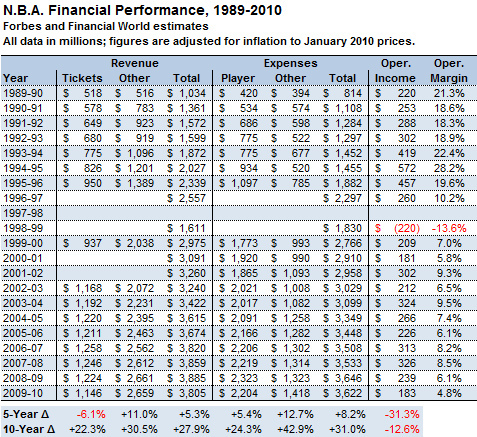
The Forbes data suggests that the NBA's ticket revenues are down 6.1% compared to five years ago. Players salaries have increased 5.4% from five years ago, but according to Silver, salaries have followed a similar trajectory to league revenues. Player salaries are strictly tied to league revenue. This is the crux of the labor dispute. As of right now, the players are receiving approximately 57% of league revenues. The league wants that number reduced to 45% or even as low as 40%. But Silver points out that the portion of revenues earned by NBA players are similar to other major sports leagues.
The data indicates growth in non-player expenses has outpaced that of salaries — 13% over five years. Silver explains this by pointing out digital media ventures and overseas investments. Still, these investments have had a major impact on the NBAs bottom line, according to Silver.
The Forbes numbers suggest that the league made approximately $183 million last season, despite player salaries and large operating expenses. The league cites their own numbers which claim a $340 million loss. Silver called into question the league's claims, citing "unusual accounting treatments" and suggested that roughly $250 million were "paper losses that would have no impact on a team's cash flow."
Silver also cited the sale prices of NBA teams including the Golden State Warriors ($450 million), Detroit Pistons ($420 million) and Washington Wizards (551 million), as signs that the market for NBA franchises is healthy and above Forbes estimations of their respective worth. Silver also suggested that the Forbes estimated worth of the New Orleans Hornets matched their own financials, proving Forbes' accuracy.
Still, the NFL made more than a billion last season and the MLB made $500 million. Silver suggested that the NBA is more comparable to the NHL. In the NHL, player salaries makes up 54% of league revenues. So why do NBA owners want to cut player salaries to 45%? Well, according to Silver, owners think they can. Cutting salaries would save owners approximately $500 million per year. This is the issue. Owners have the luxury of knowing they can wait an entire year for the players to blink, get what they want and make up the losses in three years, like the NHL.
Today, the NBA countered with statistics of their own. Their rebuttal is below and in its entirety via RealGM.
Subscribe to:
Posts (Atom)